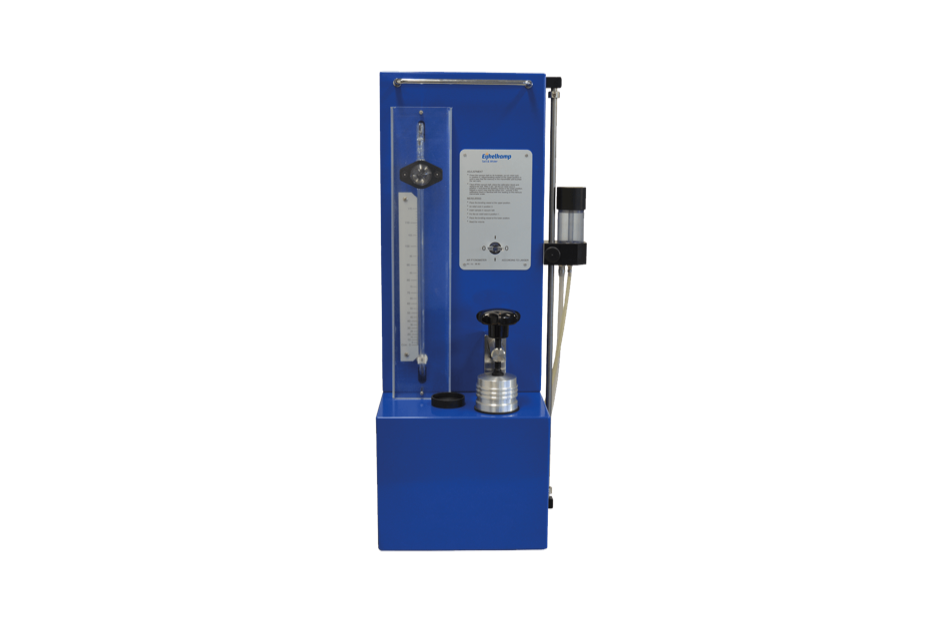
 08.60
08.60
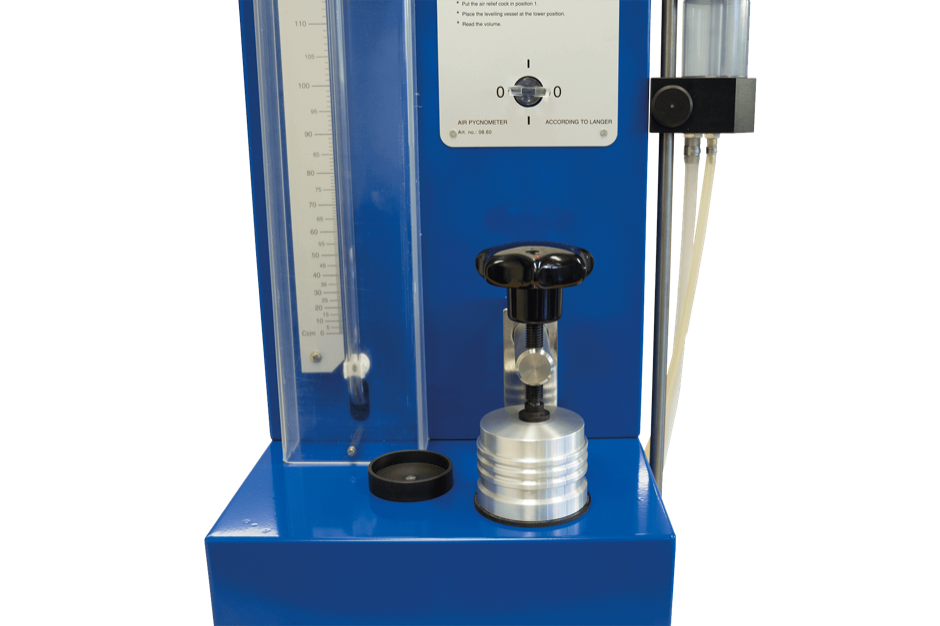
Air Pycnometer — Langer Method
A complete vacuum air pycnometer set, including a calibration block, based on the Langer method. Suits sample rings up to 53 or 60 mm diameter (max. height 51 or 40 mm respectively), with a 0–115 cm³ measurement range.
The vacuum air pycnometer is designed to determine the volume and density of solid materials such as soil samples. It applies wherever specific-gravity calculations matter: soil research (porosity determination), pharmaceutical powder/granulate investigation, road construction (tar measurement), brick manufacturing (clay analysis), and the food industry (seed and coffee-bean volumetry). The instrument is particularly useful for measuring the volume of irregularly shaped objects, and can also measure non-porous materials.
Working Principle
A low pressure (underpressure) is created in the vacuum bell holding the object to be measured. Depending on the gas volume in the bell, more or less air is drawn in. The amount of air present is independent of the volume occupied by the object being measured. Once the low pressure has stabilized, the object's volume can be read from the calibrated scale — enabling simple calibrations, and it can also be used without soil sample rings when needed.
Applications
- Determining the porosity of soil samples (100 cc soil sample rings recommended when taking undisturbed samples)
- Powder and granulate research in the pharmaceutical industry
- Measuring the pore volume of asphalt (road construction) or clay and bricks (brick manufacturing)
- Volume determination of seeds, coffee beans, pulses etc. in the food industry
- Laboratory soil density measurements
Limitation: temperature variation affects the measurement (can be avoided with climate control in the laboratory).
| Maximum Number of Samples | 1 |
|---|---|
| Measuring Range | 0 – 115 cm³ |
| Sample Property | Undisturbed |
| Parameter Measured | Porosity and density |
| Reading Accuracy | 1 cm³ |
| Sample Storage | Ring |
| Packaging Size | 101×53×50 cm |
| Weight | 13.6 kg |
Operation Manual — 08.60 Air Pycnometer
Manufacturer document (PDF, English)
Installation & Commissioning
Our expert technicians provide on-site installation and initial commissioning.
User Training
We organize hands-on field training for correct and efficient use of the equipment.
Technical Service
Our Ankara-based technical team is ready for repair, maintenance and calibration services.
Spare Parts
We support you with fast supply of consumables and spare parts.